Stable Ground Starts With Solid Support
Retaining Walls in Springfield for sloped properties prone to erosion and soil instability
C & R Concrete and Excavation LLC builds concrete retaining walls that hold back soil, control drainage, and create level ground on properties where the terrain shifts or slopes downward. You need this work when your yard loses soil during storms, when a hillside pushes against a driveway, or when you want to turn an uneven lot into usable outdoor space. The company serves residential properties throughout Springfield, Oregon, where elevation changes and water flow often require structural intervention to prevent further ground movement.
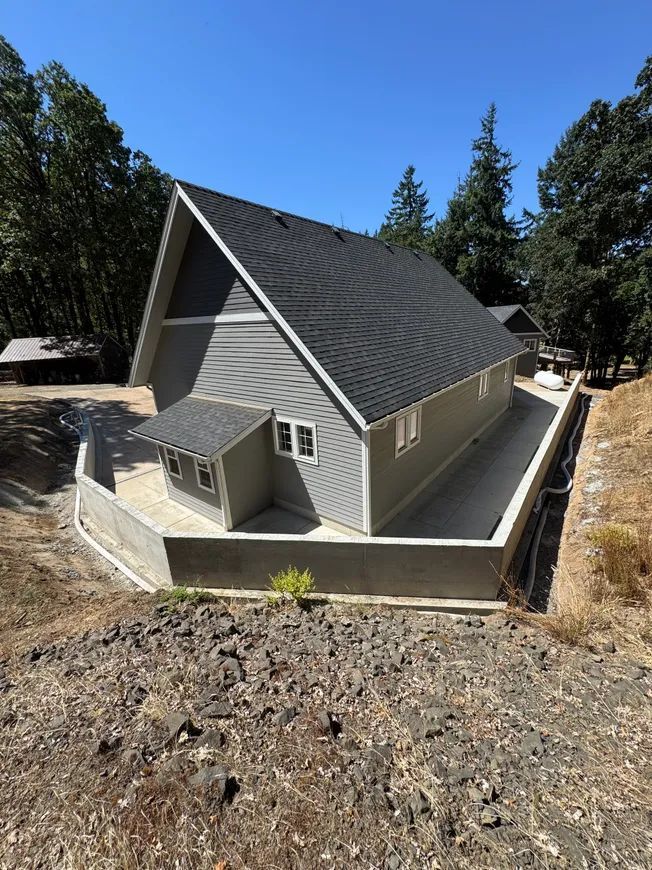
A retaining wall is a reinforced concrete structure that carries the lateral load of soil pressing against it. The crew excavates to stable ground, prepares a compacted base, and pours concrete with internal reinforcement to resist pressure from the retained earth. When completed properly, the wall redirects water away from the structure, holds the slope in place, and stops erosion from undermining adjacent surfaces like patios or driveways.
If your property has noticeable slope or visible signs of soil movement, a site evaluation will help determine wall height, footing depth, and drainage requirements.
How Concrete Walls Stabilize and Protect Property
The crew begins by marking the wall location and digging a trench below the frost line to establish a stable footing. Base material is compacted in layers, and rebar is positioned before concrete is poured. The wall is built with a perforated drainage pipe installed behind it to help redirect water away from the structure and prevent pressure buildup. Once cured, the concrete holds the soil mass in place while water is diverted to controlled discharge areas.
After installation, you will see a defined edge where the slope used to shift, a flat area where there was once a grade, and improved water flow that no longer pools against structures or washes away landscaping. C & R Concrete and Excavation LLC designs each wall to suit the specific load and drainage conditions of the property, so the structure performs as intended across wet seasons and soil settlement.
Wall construction is not cosmetic work. It requires accurate measurement of soil type, slope angle, and water table behavior. The crew coordinates grading, compaction, and forming to meet structural requirements, and backfill is added only after the concrete has fully cured. Decorative finishes or landscaping are not included in the base scope but can be planned separately once the wall is in place.
Retaining wall projects vary depending on wall height, soil conditions, and site access, so the crew evaluates your property before estimating materials and labor.
What You Should Know Before Installation
What determines how deep the footing needs to be?
The footing must extend below the frost line and reach stable soil. In Springfield, this typically requires excavation to at least 18 inches, though deeper footings may be needed on loose or saturated ground.
How does the wall handle water behind it?
The wall manages water by incorporating a perforated drainage pipe behind it, which redirects water away from the structure and prevents pressure from building up.
When should you build a retaining wall instead of regrading?
You need a wall when the slope is too steep to hold soil with grading alone, or when you want to create a level surface without removing large amounts of earth.
Why is reinforcement required in taller walls?
Steel rebar distributes tensile forces within the concrete, preventing cracks and structural failure as the wall resists soil pressure over time.
C & R Concrete and Excavation LLC provides free estimates that outline wall dimensions, base preparation, and drainage details, so you can move forward with a clear understanding of what the project involves and how the structure will function on your property.